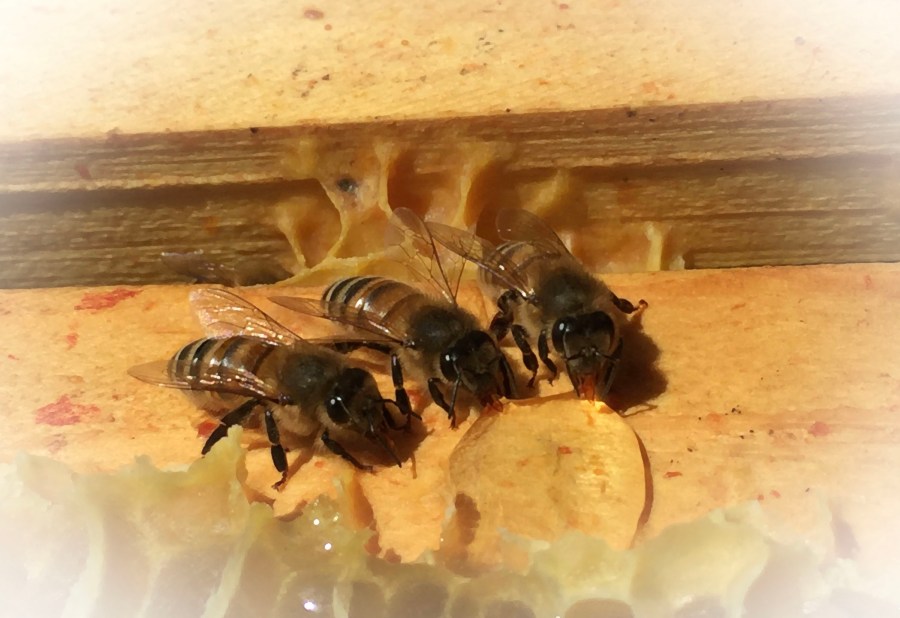
Throughout May, George and I have checked on the bees a couple of times and they’ve looked fantastic. We’ve seen no signs of mites and the queens have been laying in nice patterns, producing healthy-looking, burgeoning hives. We kept meaning to check for mites using the powdered sugar method but with all the rain we’ve had lately, it’s been difficult. Understandably, bees get pretty irate when you open the hives in the rain. You’d get pretty mad if someone took the roof off of your house when it was raining too, right? So we kept putting off the mite tests, even though we knew it needed to be done. But there weren’t any outward signs of mites, unlike last spring, so I was feeling optimistic about it.
This past weekend, Liam and I went to check on the bees to see how they’ve been doing, and finally did the powdered sugar mite tests. The process goes as follows:
- Pull out a frame and check for the queen, because you don’t want to include the queen in your sample. The frame should have lots of capped brood, and preferably with lots of drones since mites like drones the best.
- Spray the bees on the frame with sugar water, weighing them down and making it harder for them to fly.
- Taking a flat-sided measuring cup, gently run it over the bees vertically, causing the bees to fall into the cup; transfer the bees from the cup into a plastic mason jar. Continue this process until you have around a half a cup of bees (around 200 bees).
- Place a screened lid on the plastic mason jar and pour 2-3 tablespoons of powdered sugar onto the bees inside. Shake vigorously for one minute to coat the bees. (No, this doesn’t hurt them but it probably confuses the hell out of them.)
- Turn the jar upside-down and shake it vigorously up and down over a white plastic tub, so that powdered sugar and mites fall through the screen and land in the white plastic tub. The mites, which hang onto the bees’ backs, cannot hang on when the bees are coated in powdered sugar, so when the bees are shaken like this the mites fall off, through the screen, and into the tub, landing in piles of powdered sugar.
- After shaking for a full minute, set the jar aside and let the bees rest. (They’re still okay!) Count the mites. If you have more than 6 mites per hundred bees (more than about a dozen), you have an infestation and you need to treat them with medication; otherwise, you have an acceptable level and can refrain from treating them.
- Release the bees from the jar back into their hive. They will crawl around looking kind of dazed while their hive-mates lick them off. Their discomfort in the name of science is greatly appreciated.
Normally, if you have multiple hives in close proximity and you find that one has mites you don’t need to keep testing all of them; you just treat them all, since the mites are so easily passed along from one hive to the next. However, if you test a hive and there aren’t mites, you need to keep testing the hives until you’re sure there aren’t any mites in any of them. So, Liam and I tested all five of our hives, finding virtually no mites at all! That optimistic feeling I had been having earlier in May was actually warranted! No mites! Hallelujah! This is tremendous news, since mites are a major cause of colony collapse, and treating them is not only expensive and a nuisance, it slows down the growth of the hive and the production of honey. Last year we treated our hives for mites in the spring and ended up not having any honey harvest until late summer. This year it looks as though we’ll have an earlier harvest.
Two of our hives are leftover from last year, and are three hive bodies deep, all completely full with brood, honey, and pollen. They each have one super (shallower box for honey harvesting, where the queen can’t go to lay eggs) on top. On one of the hives, the super was already full of honey, albeit uncapped, so Liam and I added another super. This will keep the bees from feeling too crowded, and give them more space to work and expand. Within the next couple of weeks, they will make a wax cap on the honey in the first super, and start filling the second super with honey. The other older hive’s super was around half full, so we didn’t add another super quite yet, although we left one nearby so that next time we’re checking on them we can add it if they’re ready. We never want our bees to feel crowded; that’s when they are more likely to swarm, and we really don’t want that.
The three newer hives each just had one hive body box, and all three were full of honey, pollen, and brood when we checked them. Liam and I added another hive body box to each hive, so now they’re each two boxes deep. When doing this, we took a couple frames of brood and a couple frames of food (honey, pollen) from the first box and exchanged them for empty frames in the new box, to encourage the bees to move up into the second, new box. We want them to use that second box and expand, and not feel crowded. Moving a few of their frames into the new box helps with this.
Speaking of crowding, this is the time of year when hives grow very quickly and are most likely to swarm so whenever we check on them, we need to check thoroughly for new queen cells and destroy them. If new queens are created, it means most of the colony is getting ready to go. While we were checking the hives, I pulled out frame after frame, looking for queen cells and squashing all the ones I found. Most were empty, which is typical. Bees often create queen cells, almost out of habit. But it’s still important to get rid of those cells. There was one hive, however, that had about five queen cells with royal jelly in them, meaning they were in the process of making new queens. I took a few photos, one of which is attached on the margin and labeled. Perhaps I should find a way to collect and save the royal jelly when I find it since it is extremely valuable, but I’m not that sophisticated yet. I’ll be reading up on it, though.
When checking the hives, Liam and I also noticed thousands upon thousands of fuzzing golden bees with downy fur around their beady little black eyes, shiny wings remaining folded. These were brand new babies, hatched within the past day or so, not ready to fly yet. I attached a photo of some babies on the margin, too. When babies emerge from their cells, they slowly poke their way out, soliciting passersby for any food to help them get through the entire process. Once out, they look like ugly alien creatures. They fluff themselves and stay sitting on the comb for a couple of days, feeding. From this stage, they become caretakers, feeding other babies, cleaning out cells, and tending to the queen, until they are ready to take their maiden flight and begin foraging.
All-in-all, Liam and I spent nearly four hours checking the hives. The end result was:
- No mites in any of the hives
- One super full of uncapped honey (and it’s not even June yet!)
- We couldn’t find any of the queens, but they’re obviously working hard and laying well
- Lots of brood, lots of babies
- Lots of queen cells, most empty (typical), some with royal jelly, all destroyed
- More space added to 4 out of 5 of the hives to prevent swarming
And to end on the best possible note, it didn’t rain, neither of us got stung, and neither of us found any ticks on us afterward despite wading through a field of grass and alfalfa that was up to my chin. On the way home, we stopped at DQ and picked up blizzards to celebrate! We were tired, but tickled with the results of the day.
 Tenacious Bee